


The health benefits of Pu-erh tea, particularly its ability to regulate glucose and lipid metabolism, have gained widespread attention in recent years. On April 17, Professors Wei Jia and Aihua Zhao from Translational Medicine Center published their latest research in Advanced Science. The study reveals, for the first time, a novel sex-specific hypoglycemic pathway for theabrownin (TB), a key pigment in Pu-erh tea: it significantly enhances the inhibition of -glucosidase by binding with the intestinal mucin MUC2, thereby lowering postprandial blood glucose. This mechanism is notably more effective in females, providing a new perspective for personalized nutritional interventions.
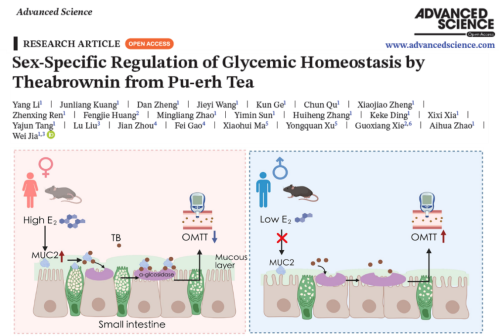
Extensive research has demonstrated that Pu-erh tea improves blood glucose and lipid profiles. A study published by the Center for Translational Medicine in Nature Communications in 2019 confirmed that TB in Pu-erh tea effectively lowers cholesterol levels by modulating gut microbiota to alter bile acid composition. Recent investigations into its glucose-lowering effects found that after consuming Pu-erh tea or TB, the reduction in postprandial blood glucose in females was significantly greater than in males. This phenomenon was confirmed in both hyperglycemic human populations and diabetic mouse models, where the activity of intestinal a-glucosidase was significantly inhibited in females.
The research team conducted an in-depth analysis of small-molecule metabolites and macromolecular proteins in the intestinal contents that might influence -glucosidase activity. They discovered that estradiol levels in the female intestine were significantly higher than in males and were positively correlated with the glucose-lowering effect of TB. Further investigation revealed that estradiol promotes the expression of the intestinal mucin MUC2 in a dose-dependent manner, with MUC2 expression in female mice being approximately 1.5- folds that of males. Subsequent studies showed that when TB forms a TB-MUC2 complex through non-covalent bonding, it exerts a marked inhibitory effect on -glucosidase. The inhibition rate approaches that of Acarbose, a commonly used clinical drug, and acts as a reversible non-competitive inhibitor. The critical role of the TB-MUC2 complex was further validated by removing estradiol or knocking out the MUC2 protein.
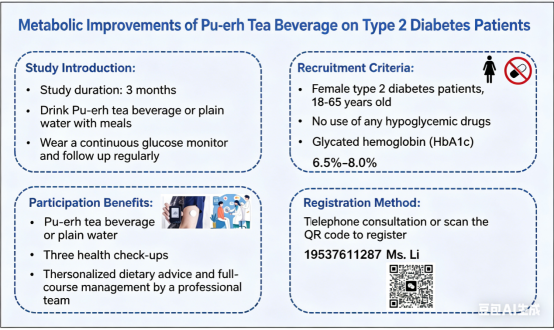
While Pu-erh tea provides a "foundational hypoglycemic strategy" for hyperglycemic patients (including regulating microbiota and bile acids, promoting GLP-1, and inhibiting gluconeogenesis), females possess an additional "booster" due to higher estrogen levels. In females, TB joins forces with estrogen-regulated MUC2 to inhibit intestinal -glucosidase more efficiently, further reducing postprandial blood glucose. Based on this research, Translational Medicine Center, in collaboration with the Department of Endocrinology and Metabolism, is currently conducting clinical trials on the hypoglycemic effects of Pu-erh tea. (Scan the QR code for inquiries.)
Full Citation:
Yang Li#, Junliang Kuang, Dan Zheng, Jieyi Wang, Kun Ge, Chun Qu, Xiaojiao Zheng, Zhenxing Ren, Fengjie Huang, Mingliang Zhao, Yimin Sun, Huiheng Zhang, Keke Ding, Xixi Xia, Yajun Tang, Lu Liu, Jian Zhou, Fei Gao, Xiaohui Ma, Yongquan Xu, Guoxiang Xie*, Aihua Zhao*, Wei Jia*. Sex-Specific Regulation of Glycemic Homeostasis by Theabrownin from Pu-erh Tea.Advanced Science, 2026; 0:e19337. https://doi.org/10.1002/advs.202519337
News
- Connecting China and Argentina Through Healthcare Innovation: Argentine Delegation Visits Shanghai Sixth People’s Hospital09-29
- Shanghai Sixth People’s Hospital ENT Team Presents at IFOS 202609-16
- Professor Wei Jia and Aihua Zhao’s Team Discovers Pu-erh Tea’s Hypoglycemic Effects Favor Females04-18
- Shanghai Sixth People’s Hospital Welcomes BDMS Delegation to Advance International Collaboration03-30
- Call for Applications: 2026 NSFC Excellent Young Scientists Fund Program (Overseas)02-11
- Shanghai Sixth People’s Hospital Delegation Visits Leading UK Universities02-04
- Shanghai Sixth People’s Hospital and Indonesian Ministry of Health Launch Joint Neurointerventional Training Program10-18
- 16th SJTU Medical Imaging Summit Forum and 2025 Advanced Seminar on Neurointervention and Neuroimaging Held in Shanghai10-16
